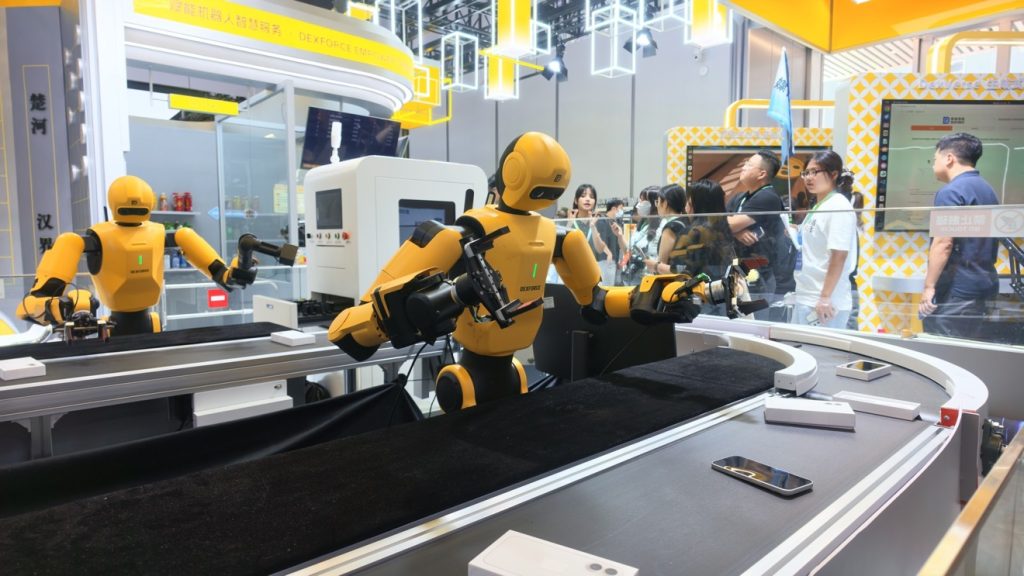
Are Chinese humanoid robots actually working in factories? Some are, but mostly on trial. SouthwardTech checked 41 named deployments at their original sources: 20 are on-site trials and nine are training or tests. Six buyers say the robots do production work, and none has said what it paid.
Takeaways
- SouthwardTech checked 41 named deployments at source: 20 are trials and 9 are training or tests.
- Six buyers say the robots do production work, and none has disclosed a price.
- The buyers that give a count account for fewer than 40 robots.
At an auto-parts plant in Hangzhou’s Xiaoshan district, 15 humanoid robots made by Leju now load parts on to machining lines. Getting there took months. “At first the robots couldn’t stand. They fell over and couldn’t hold anything,” Zhaofeng chairman Kong Aixiang told Yicai in October, adding that the robots trained about 15,000 times on gripping parts alone.
The line now runs at a 98% success rate, according to Yicai. That makes Zhaofeng one of the most fully documented humanoid deployments in Chinese manufacturing. It is also one of the few.
China is pushing hard to put humanoids to work. A notice issued in June by the Ministry of Industry and Information Technology and the state-asset regulator calls for humanoids in routine use at the scale of tens of thousands of units by the end of 2026, with progress reports due on 30 November. More than 22,000 humanoids were shipped worldwide in the first half of the year, most of them made in China, according to Counterpoint Research.
On the factory floor, the picture is thinner. SouthwardTech identified 50 named deployments of Chinese humanoids at factories and warehouses and checked each against its original source. Of the 41 whose sources could be read, 20 are on-site trials and nine are training or tests. The rest are contracts, plans or claims with no primary source. No buyer has said what it paid.
Small numbers
When buyers speak for themselves, they describe a handful of robots.
SAIC Motor says one AgiBot robot works on the battery line for the Buick Electra E7 at its joint venture with General Motors. An engineering director at Fulin Precision told Yicai in July 2025 that four AgiBot robots had been installed to sort parts. Longcheer, a contract electronics maker, says AgiBot robots on its main tablet line in Nanchang run more than 10 hours a day. CATL says Galbot robots are “in regular operation” on its production lines, but gives no count. A Siemens plant in Nanjing uses one Galbot robot to move motherboards, staff told China News Service.
Across all the buyers that give a number, the total is under 40 robots, according to SouthwardTech’s tally.
The larger figures in circulation come from the robot makers or from reporters’ narration, not from the buyers. Nine of the 20 trials in the ledger rest on the maker’s word alone. Whether a robot is doing useful work is a different question from whether it is on the line.
Close relationships
Several of the most confident buyers are not ordinary customers. Longcheer is a shareholder in AgiBot. Fulin and AgiBot both hold stakes in an integrator. Zhaofeng owns 80% of a joint venture with Leju that has since won a 300 million yuan robot-services tender, according to Securities Daily.
That does not make their accounts wrong. It does mean that the clearest evidence of humanoids doing factory work comes from companies with a stake in the outcome.
Buyers with no such ties tend to be more guarded. Foton Cummins has tested two robots from the Beijing Humanoid Robot Innovation Center at its Changping engine plant for nearly a year. They “still cannot fully replace one worker,” a plant manager told STAR Market Daily in August. Airbus described its work with UBTech as “in the early concept-testing stage”, Reuters reported.
Where the robots go
The makers’ own numbers point the same way. Industrial uses made up 9.01% of Unitree’s humanoid revenue in the first nine months of 2025 and 3.88% of Leju’s, according to a Guoyuan Securities analysis of their listing documents. Unitree told the Shanghai exchange that industrial applications are “mainly in the validation and promotion stage”. (More on Unitree’s listing.)
Most humanoids go elsewhere. Education, performance and government data-collection centres took 69% of shipments in the first half of 2026, according to IDC. Counterpoint puts the share going to intelligent manufacturing at 13%.
Analysts have flagged the gap. The International Federation of Robotics said in May that production use of humanoids is “currently limited to demonstrators or pilot projects”. Units in real industrial settings “remain relatively limited,” UBS analyst Phyllis Wang told Yicai in May. She named repeat orders as the measure to watch.
Abroad
Overseas deployments are earlier still. The most advanced is at Ajin Industrial in South Korea, where several UBTech Walker S2 robots are in a verification project, Autodaily reported on 10 November. Rossmann in Germany is testing one robot, and ID Logistics two. (See also China’s robot exports to developing economies.)
What’s next
The 30 November progress reports may be the first official count of humanoids at work, if they name sites and units.
At Zhaofeng, the payback is still some way off. Kong expects to see a return on the investment after three to four years, Yicai reported. The 21st Century Business Herald, which also visited the plant, described the work as still at the concept-validation stage, ahead of any small-batch orders.
How we did it
SouthwardTech compiled two independent lists of deployments from news reports, company releases, exchange filings and tender notices, then merged them into one row per maker, customer and site. The two lists gave a different status to 17 of the 30 deployments they shared, so every row was checked against its original source. We counted humanoids, including wheeled humanoids, at factories and warehouses, and left out shops, training and data-collection centres, and makers’ own plants. Each row is graded by who is speaking: the buyer, an independent third party, the maker only, or a second-hand source. Nine sources could not be read and are not counted. Sources were read on 20 and 21 November 2026.
| Stage | Deployments | Of which buyer confirms |
|---|---|---|
| Trial | 20 | 8 |
| Training or test | 9 | 5 |
| Contract, plan or announcement | 8 | 1 |
| Unconfirmed claim | 4 | 0 |
| Total read | 41 | 14 |
We update this ledger every Thursday. Quotes originally in Chinese are SouthwardTech translations.
Last updated: 21 November 2026.
Questions and answers
Are Chinese humanoid robots working in factories?
Some are, but mostly on trial. Of 41 named deployments SouthwardTech checked at source, 20 are on-site trials and nine are training or tests. No buyer has disclosed what it paid.
How many humanoid robots work in Chinese factories?
No official count exists yet. The buyers that give a number account for fewer than 40 robots in total. The largest buyer-confirmed count is 15 Leju robots at Zhaofeng in Hangzhou. Government progress reports are due on 30 November 2026.
Which companies say Chinese humanoids do production work?
Six buyers: CATL, SAIC-GM, Longcheer, Fulin Precision, Zhaofeng and a Siemens plant in Nanjing. Three of them, Longcheer, Fulin and Zhaofeng, have ownership ties to the robot maker.
How much of humanoid demand comes from factories?
A small share. Counterpoint Research puts intelligent manufacturing at about 13% of shipments in the first half of 2026, and IDC says 69% went to education, performance and data-collection centres.