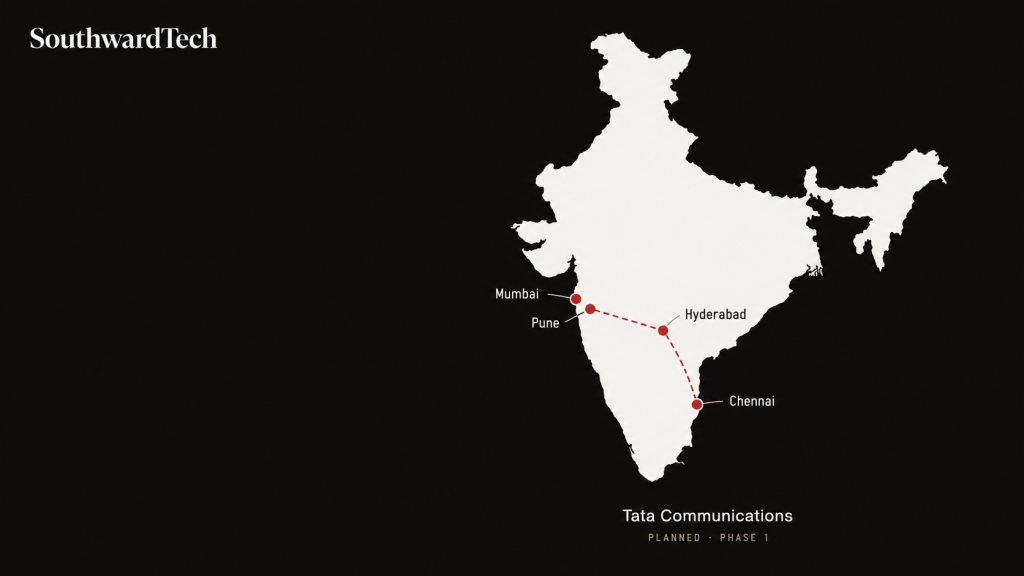
Indian telecommunications company Tata Communications plans to invest US$400–450 million in a fibre-optic network linking the country’s AI and data centre hubs, targeting the connections needed to move data between computing facilities and overseas markets. Announced on October 26, the roughly 10,000-kilometre network would be built in three phases.
The proposal comes weeks after US AI cloud provider CoreWeave announced a separate project with data centre developer AdaniConneX for 240 megawatts of data centre capacity in Navi Mumbai, near Mumbai on India’s west coast. CoreWeave expects its first phase to be available in mid-2028. The separate projects highlight two parts of India’s AI expansion: facilities to run AI systems and networks to carry data between them and their customers.
Tata’s first phase would link Mumbai and nearby Pune in western India with Hyderabad and Chennai in the south. Later phases would extend to other data centre locations along the east coast and in western India. The 10,000-kilometre figure covers the full programme; the announcement did not give completion dates for individual phases.
The intended customers include large cloud computing companies, AI platforms, newer cloud providers and other businesses. Tata said the network would connect Indian data centres to its global network and to landing stations, where international undersea cables connect to networks on land. The aim is to support data transfers between India and overseas AI hubs, with high capacity, short transmission delays and reliable connections.
Rupesh Chokshi, Tata Communications’ head of network services, told Indian business news outlet Moneycontrol that connectivity could constrain AI expansion if the necessary infrastructure was not built. He said customers’ needs would vary depending on whether they were training AI models, running those models locally to generate outputs, or serving overseas markets from India.
Chokshi said the network’s competitiveness would depend on fibre quality, network construction and its ability to meet service commitments for speed, capacity and reliability. Tata also plans to expand its existing long-distance and city networks to continue serving business and data centre customers while building capacity for future demand.
The company was in advanced customer discussions but had not announced contracts for the proposed network at the time of the October 26 interview. The report did not identify customers or contract values for the new network.
Tata plans to spend the money over three to five years, prioritising routes according to expected data traffic, capacity needs and the pace of data centre development, Chokshi told Moneycontrol. That is an investment timeframe, rather than a confirmed deadline for the entire network to enter service.