AI services usually bill input, output and cached tokens at different rates, so a price per million tokens only means something once you know which category, which model and which time period it covers.
An AI service may quote a price per million tokens, while a subscription may offer a bundle of credits. To turn either offer into a budget, ask four questions: what does the quoted number measure? How does usage become a bill? What do credits convert into? What does an acceptable result cost in total?
What does the quoted number measure?
For text models, tokens are pieces of text a model processes, such as a word or part of a word. Input tokens count material sent to it; output tokens count what it generates. A price per million input tokens therefore buys a different part of the service from a price per million output tokens.
Cached input is text the service can reuse from an earlier request. Reuse must meet the provider’s cache conditions; where a tariff prices cached input separately, qualifying usage has its own rate. Repeating a prompt does not by itself establish a cache hit. The categories and conditions matter as much as the headline price.
How does usage become a bill?
For prices quoted per million tokens, divide each category’s billable token count by one million, multiply by that category’s applicable rate for the model and time period, and add the charges.
Model usage charge = sum of (billable tokens in each category ÷ 1,000,000 × applicable rate per million tokens).
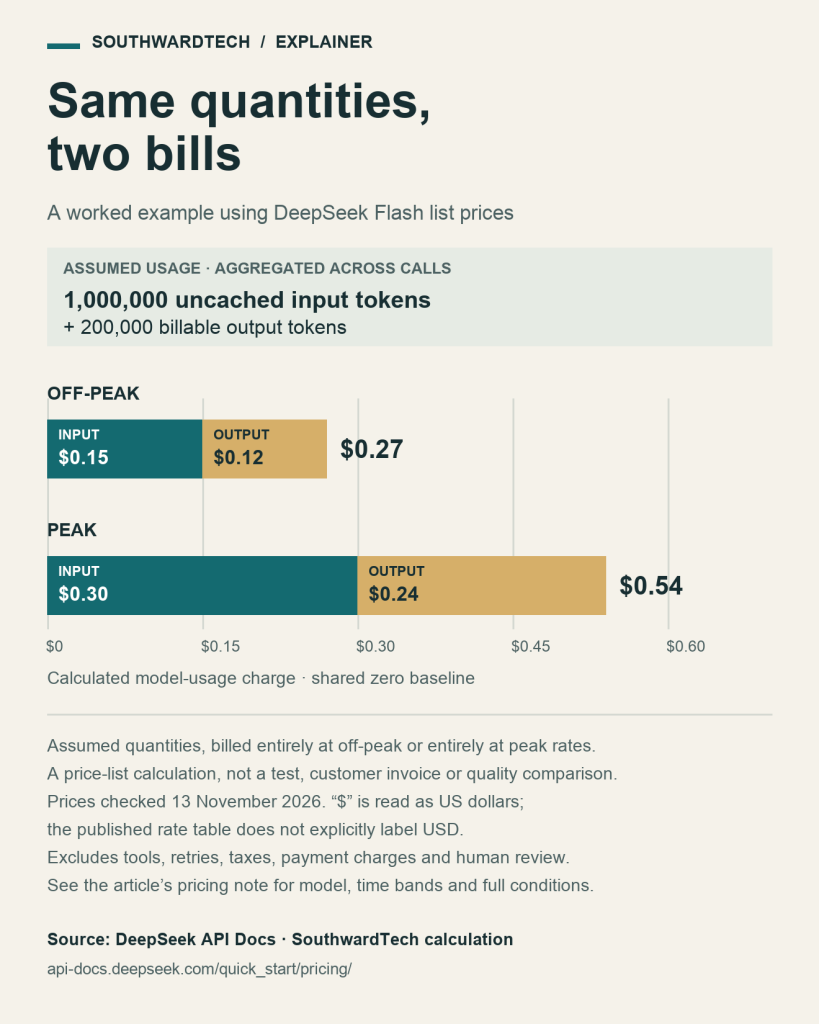
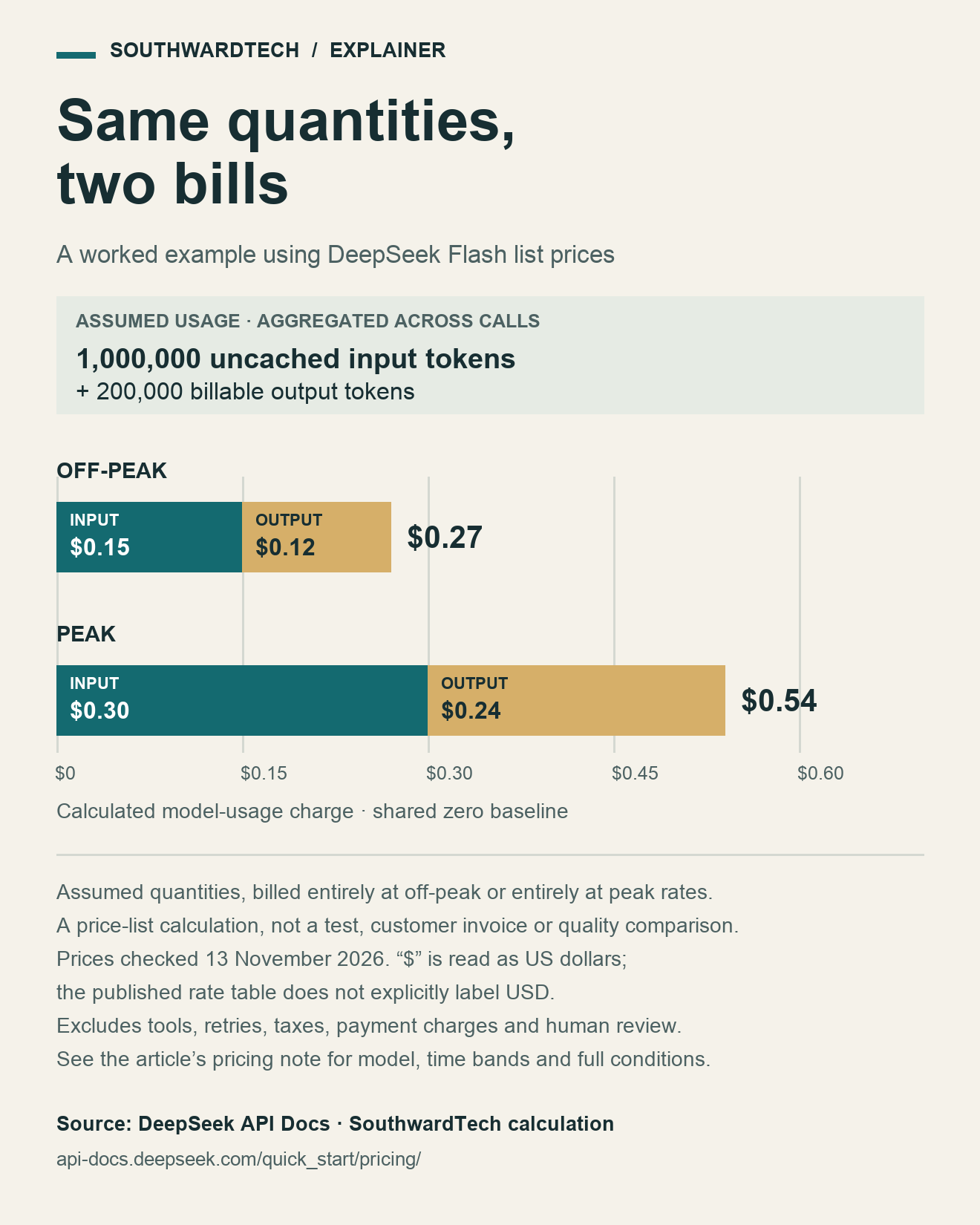
DeepSeek’s Flash tariff, checked on 13 November 2026, supplies a dated example of direct API pricing. Suppose a workload totals one million uncached input tokens and 200,000 billable output tokens, aggregated across multiple calls. Compare two scenarios: all that usage billed at off-peak rates, or all of it billed at peak rates. These are assumed quantities, not measured consumption for a particular task.
At the rates checked, off-peak input/output prices per million were $0.15/$0.60: $0.15 + (0.2 × $0.60) = $0.27. Peak prices of $0.30/$1.20 gave $0.54. Timing changed the calculated charge for those quantities. This is a calculation from published rates, not an API test, an actual customer invoice or a comparison of model quality. The conditions behind these figures are set out in the pricing note at the end.
| Assumed usage | Off-peak charge | Peak charge |
|---|---|---|
| 1 million uncached input tokens | $0.15 | $0.30 |
| 200,000 billable output tokens | $0.12 | $0.24 |
| Total model usage charge | $0.27 | $0.54 |
Assumed quantities aggregated across multiple calls; all usage in one tariff period. Calculation from DeepSeek rates checked 13 November 2026, not an API test or customer invoice. See the pricing note for model, time bands, currency interpretation and excluded charges.
Are token credits the same as model tokens?
A credit package adds an exchange step between payment and metered usage. China Telecom illustrates the distinction. A product introduction carried by Xinhua Net on 11 November 2026 described a monthly 9.9-yuan package containing 1,000 “Tianyi tokens” (天翼词元): credits redeemable for model usage.
For GLM5.3, it said 1,000 credits could cover 1.25 million input tokens, or 357,000 output tokens, or 5 million tokens of cache-hit usage. These were alternative uses of one allowance, not separate balances to add together. A million tokens of a particular usage category and a thousand provider-defined credits are different units.
The description put purchases through China Telecom’s app and telecom account balance, with AI consumption joining the phone bill. SouthwardTech has not independently checked the app’s current exchange table or contract terms. The published examples cannot settle exactly how a mixed workload would consume the credits, or whether the package would suit a particular buyer.
What should buyers compare?
SouthwardTech’s token-factory explainer examines the businesses behind inference supply. For a customer comparing offers, the practical questions are:
- Which model will perform the work, and can my intended application use it?
- Which usage categories and tariff periods determine the bill?
- If the offer sells credits, how do they convert into model usage?
- What eligibility, expiry, renewal and overage conditions apply?
- What will retries, tools and human checking add to the cost of an acceptable result?
A low token price can be offset by repeated attempts or lengthy checking. A higher-priced model could need fewer attempts. Those possibilities need testing against the buyer’s own work; a tariff table cannot settle them. The useful comparison is the total cost of producing work that meets the requirement, with the billing unit and assumptions made explicit.
Pricing note: conditions of this dated example
- Model and dates: The 13 November 2026 check covered deepseek-flash, serving DeepSeek-V4.1-Flash-1017. The rates took effect at 04:00 UTC on 10 September 2026; the 17 October change log said the subsequent upgrade left pricing unchanged. Recheck the vendor’s table before budgeting new work.
- Time bands: The listed peak periods were 01:00–04:00 and 06:00–10:00 UTC, Monday to Friday, excluding Chinese public holidays. All other times, including weekends and those holidays in full, were off-peak. Treatment of calls spanning a tariff boundary was not verified.
- Currency: The calculation reads “$” as US dollars, consistent with DeepSeek’s CNY/USD balance documentation, although the rate table did not explicitly label the currency. Actual account billing currency was not checked.
- Scope: Only the specified model usage is included, with no cached input. Search/fetch tools, retries, taxes, payment charges and human review are excluded. Account-specific charges were not verified.
Related reading
- Can China’s “token factories” ease Southeast Asia’s compute squeeze?
- China’s Runjian signs $200m deal to sell AI computing to an overseas buyer
- Guangdong Power Grid unit eyes Peru for AI ‘token exports’
More in Token Economy.