Of the three companies, only Baidu’s 16 November results reported growth in revenue from outside customers’ token use: up 1,159 per cent year on year on its Qianfan platform, with no amount or geographic breakdown. Alibaba reported 64 per cent growth from external customers in its AI cloud and compute division, where “external” means outside the Alibaba group, irrespective of country.
Key facts
- Reported: Baidu gave a growth rate for revenue from token use, Tencent gave a daily token count for WorkBuddy, and Alibaba reported revenue from a broader set of AI products.
- In use: Alibaba Cloud describes a document-reading workflow at Lion Parcel. Indonesian telecoms operator XLSMART confirmed a separate cloud migration with Tencent.
- Not yet confirmed: The three companies’ overseas AI cloud revenue or split by workload, the share of WorkBuddy tokens that were billed, and Lion Parcel’s actual spend.
Three companies, three different measures
Alibaba’s 19 November filing put September-quarter AI Cloud and Compute Services revenue at 60.97 billion yuan, up 53 per cent year on year. The division includes chip designer T-Head.
Alibaba separately reported 17.92 billion yuan in AI-related product revenue. That figure covers a wider range of products than model API calls.
Baidu said AI Cloud Infra revenue rose 94 per cent to 8.2 billion yuan. Its separate Qianfan figure tracks growth in revenue from token use rather than growth in the number of tokens processed.
Tencent said on 18 November that cloud services revenue rose 35 per cent, citing AI demand and international expansion. It also said its WorkBuddy assistant had recently been consuming more than 100 trillion tokens a day.
That daily figure measures usage across a service that management said mixes subscriptions, usage-based charges and temporary free access. Tencent did not disclose how much of that usage was billed.
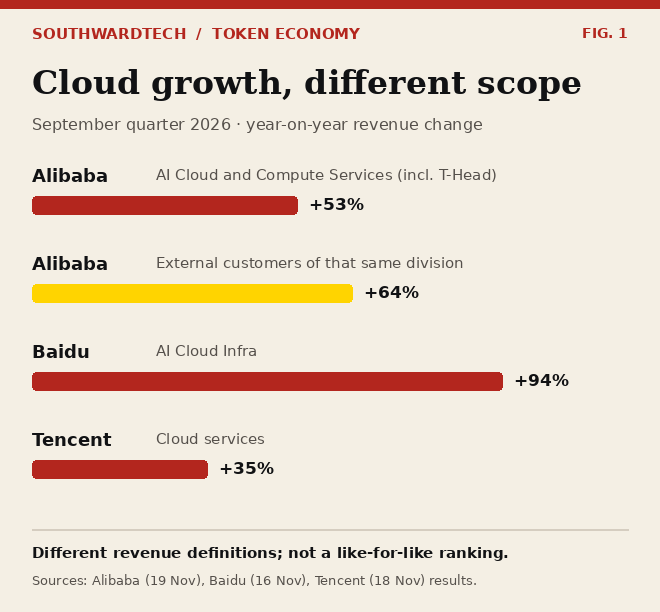
Figure 1. September-quarter revenue growth, year on year: Alibaba AI Cloud and Compute Services (+53%); that division’s revenue from customers outside the group (+64%); Baidu AI Cloud Infra (+94%); Tencent cloud services (+35%). These are different revenue measures, not a ranking or a measure of overseas token sales.
Why cloud profits can rise while AI apps lose more
Alibaba’s cloud and compute division reported adjusted EBITA of 8.84 billion yuan up from 4.00 billion a year earlier on a restated basis. Its AI Labs and Applications division’s loss on the same measure widened from 3.44 billion to 10.50 billion yuan.
Alibaba attributed the wider loss to greater AI investment and higher inference costs, the cost of running the model when people use its Qwen app. In SouthwardTech’s reading, selling more cloud computing and spending more to serve an AI app can happen at the same time; the segment figures are too broad to show profit per model call.
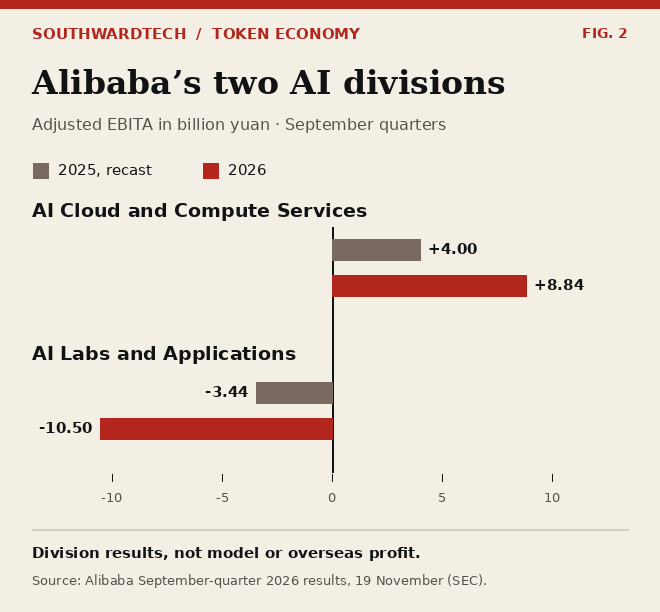
Figure 2. Alibaba’s two AI divisions. Adjusted EBITA, not net profit; September quarters, 2025 figures recast.
How two Indonesian companies use Chinese cloud services
In an Alibaba Cloud case study, Lion Parcel’s head of IT described using a Qwen-powered tool to read delivery orders for its finance team. Alibaba Cloud identifies the model as Qwen-VL-Plus and says it is priced per token through Model Studio.
The published case gives a pricing model rather than a bill. Lion Parcel’s spend, the invoicing entity and the location where the model ran remain unknown.
Indonesian telecoms operator XLSMART says it moved 1,200 microservices to Tencent Cloud using tools including CodeBuddy and WorkBuddy. Tencent announced completion on 26 June.
The companies describe a software migration and give no separate token charges. In SouthwardTech’s assessment, that’s a different use of AI from calling a model to process delivery orders; the two projects show what’s possible, rather than what overseas customers buy most often.
What to look for next
The next useful disclosure would tie a named overseas customer’s workload to a bill: what was metered, which company invoiced it and where the model ran. A geographic breakdown separating model calls, rented GPU capacity and cloud migrations would also make future results easier to compare.
A US rule that took effect on 19 November adds licensing requirements for certain advanced computing items tied to large-scale remote access by covered entities, with no public evidence tying either Indonesian project to the rule.